Strombolian Eruption
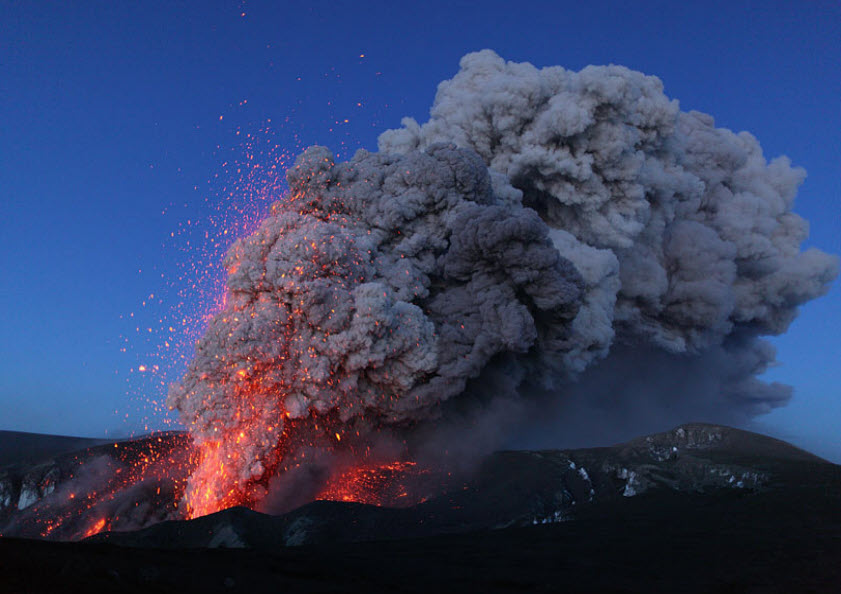
On the 18th of April 2010 the first phase of the eruption came to an end and the second phase started. The activity of the eruption changed from being a phreatomagmatic eruption to a strombolian eruption. Strombolian eruptions are relatively low power eruptions and characterized by both lava flows and ejection of tephra away from the eruption site by small explosions. The larger tephra fragment will start to build up a cinder cone (crater) but finer tephra is carried away from the eruption site in a low lying plume. The explosions happen due to the buildup of gas pressure in the uppermost part of the lava in the crater, and it can take anywhere from seconds to minutes between each explosion.
The reasons for the change in the activity are that the ice around the eruption sites had been melted away and water was no longer able to enter the vents, and that the erupting lava became less silicic, both of which cause reduced explosive activity. The power of the eruption decreased during this phase as well, but the flow of lava was still estimated at 20-50 tons per second. During this phase the eruption was classified as a mixed eruption, with neither tephra nor lava production constituting more than 95% of the erupted material. The ash produced during this phase was much coarser than from the previous phase and was also not carried as high up into the atmosphere with the plume. The eruption plume from the eruption became smaller and reached much lower into the atmosphere than during the first phase, and as tephra production had decreased the column became much lighter in color.
The fissure that opened on the 15th of April became the main hub of activity, and remained until the end of the eruption, and a spatter cone was formed. The lava produced during this phase extended to about 3 km away from the spatter cone and flowed down and through the outlet glacier of Gígjökull. A large canyon was formed in the ice there due to ice melt from the lava, and the outlet glacier has yet to recover from this. The ice melt produced large quantities of water which entered the river of Markarfljót, but it did not cause large scale flooding.
The second phase lasted until the 4th of May, but in the days prior the explosive activity had increased and would increase even further in the coming days. That shift in activity marks the end of the 2nd phase and the start of the 3rd phase.
Tuff forms in volcanic eruptions where the lava cools down rapidly due to interaction with water, which fragments the lava into glassy tephra. The tephra, which is often fine grained and dark in colour (ash), settles and then starts to solidify and forms fine grained tuff.
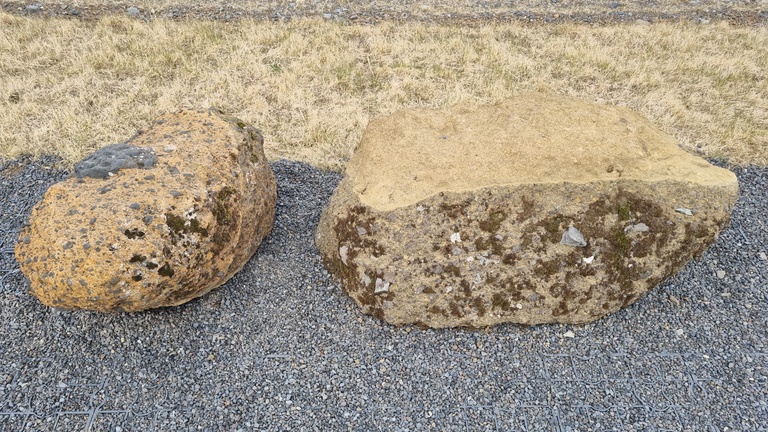
The Móberg (Palagonite) formation of Iceland is mainly the volcanic material that was formed due to eruptions under glaciers or in the sea in the latter part of the Ice Age, 0.78-0.01 million years ago. The formation covers an area of about 11,200 km2 and can be found on all current active volcanic belts in the country. The formation consists not only of palagonite, as the basic units of the formation are also pillow lavas, intrusions, and lava flows. Hyaloclastite ridges and tuyas are common in the formation and many examples of them can be seen within Katla Geopark. There, the different strata of the Móberg formation can often be seen, such as cube jointed basalt, basalt columns, palagonite and palagonite breccia. The different strata can all form in the same eruption, but under different conditions during the eruption itself.
Palagonite is formed when magma cools rapidly during an eruption under a glacier or in the sea, but then the magma fragments and forms volcanic ash instead of lava. The ash then settles around the eruption vent and is then called volcanic tuff. The tuff soon undergoes chemical alteration so that it glues together to form rock, which is then called palagonite. The Palagonite breccia is formed under the same conditions, but when the fragmenting of the magma is not as forceful so that pieces of lava settle in the ash. Cube jointed basalt is formed by the rapid cooling of lava, lava that is either intruded into the tuff deposits or in a lava flow once water can no longer reach the eruption vent. The basalt columns are formed under the same conditions but with slower cooling than when cube jointed basalt is formed, but basalt columns can often be seen either below or on top of a layer of cube jointed basalt.
Celebrating Earth Heritage
How to visit the Katla Geopark
Katla UNESCO Global Geopark is in central South Iceland